
If you wanted to take advantage of the Idaho Department of Agriculture's pesticide disposal program in Eastern Idaho, you have "missed the boat". But there are still four opportunities to get rid of unwanted pesticides in a safe way.
Burley September 29th BLM Burley Field Office, 3630 Overland
Twin Falls September 30th Twin Falls Canal Company, 357 6th Avenue
Gooding October 1 Gooding Airport, 1945 Airport Road
Collections are 9 AM to 1 PM each day.
Please check with the local ISDA field office or the state office at 208-332-8628 to confirm the pickup or for additional information. You can also find out more about the program at www.agri.idaho.gov.
Thursday, September 4, 2014


Range Monitoring Workshop September 18th
Click on image to enlarge
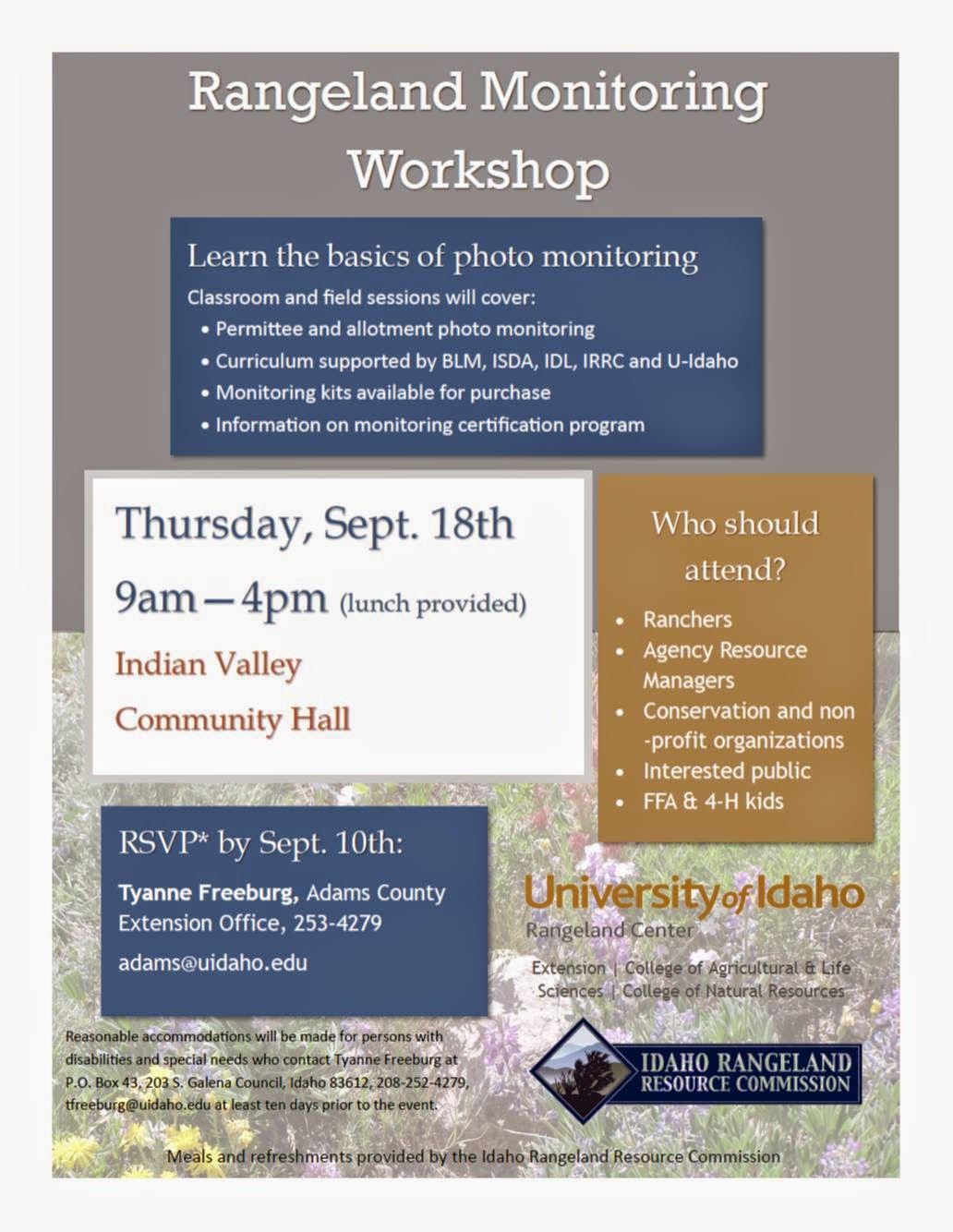 The agenda is approximately as follows:
9:00 Welcome,
introductions, pre-test
9:15 Intro
to Range Monitoring (classroom presentation with terms, methods)
10:15 Break
10:30 Travel
to field sites and field exercises (please carpool)
12:30 Lunch
(guaranteed to RSVP’ed participants)
1:30 Travel
back to classroom
2:30 Classroom
time for photo critiques and carrying capacity calculations
3:30 Post
test, Evaluations
4:00 Adjourn
Clover Root Curculio Is an Increasing Reason for Stand Loss in Alfalfa

"Clover Root Curculio in Alfalfa: Identification, biology and management" is now available as PNW663. The publication described the insect, damage and suggested practices for control. It is available only on line at http://www.cals.uidaho.edu/edComm/pdf/PNW/PNW663.pdf .
Saturday, August 30, 2014
Rain Damaged Grain May Offer Feeding Opportunity for Beef Producers
John B. Hall, Ph.D., PAS
Extension Beef Specialist, University of Idaho

 behind damaged hay and grain fields. Barley that sprouted in the head and rain damaged wheat may be an opportunity for feeding beef cattle. This may partially offset losses that grain growers have incurred. Even grain that has low levels of mold and mycotoxin may be fed to beef cattle without any negative effects. However, beef producers and nutritionist need to know the mycotoxin content of feeds before purchase.
Performance of cattle fed damaged cereal grains
Several university studies have demonstrated that cattle perform well on rain damaged grains. In general, performance is not compromised when sprouted grains are incorporated into the diet on a dry weight basis (Tables 1, 2 & 4).
Thursday, August 28, 2014
What to Do with Moldy Hay
by Glenn Shewmaker, Extension forage specialist (gshew@uidaho.edu); Oliver Neher, Extension Plant Pathologist (oneher@uidaho.edu); Mireille Chahine, Extension Dairy Specialist (mchahine@uidaho.edu); and Benton Glaze, Extension Beef Specialist (bglaze@uidaho.edu); University of Idaho
 Weather conditions prior to, during first cutting, and while making hay have been very moist. Many areas have 2 or more inches of above normal precipitation. Much hay has been rained on or left lying in the field for prolonged time periods due to cool and humid conditions which reduced drying rates. The long drying periods with high humidity allowed field growth of mold on the hay. We will try to state some facts and offer some recommendations for hay producers and livestock producers.
What is the "black dust" that covers my mower or swather?
• The black dust is most likely spores produced by fungal organisms. Spores are how the fungi reproduce and are always present but usually at lower concentration. The black dust on a mower or swather indicates that fungal growth was present prior to cutting.
Wednesday, August 27, 2014
Combine moisture readings likely inaccurate

Each rain event
contributes to additional deterioration of grain quality. While the
objective is to harvest as quickly as possible, if the grain is going to be
stored for later use as feed (or ethanol, etc), please DO NOT harvest at high
moisture content. Already moldy grain will continue moldy growth unless the
moisture is below 12%. To arrest growth, harvest below 12% and keep air
flowing in the bins.
Moisture
sensors in the combine are unlikely to be accurate for sprout damaged grain!
Monday, July 7, 2014
Stripe Rust Reported in Eastern Idaho

Stripe
rust has been reported in UI Pettit in the Rockford area south west of
Blackfoot.
Stripe
rust has been reported in WB936 on west side of Idaho Falls.
Stripe
rust has been reported in a spring feed barley (http://www.westbred.com/Products/Northwest/Barley%20Documents/WESTBRED_501.pdf)
north of Rupert. The barley was in milk to soft dough. Fungicide application is
not recommended for the barley, and in addition the allowable time frame has
passed for fungicide application in that field.
Subscribe to:
Posts (Atom)